An energy auditing app that reads energy labels and electricity bills with the camera. First place and a $2,500 prize at the 2023 FHSU Entrepreneurial Challenge.
Overview
Situation
An energy label is on every appliance sold, and almost nobody reads one. The information is there (efficiency class, annual kWh, performance ratings) but it arrives as a dense grid of icons and numbers at the exact moment a shopper is deciding on price instead.
The electricity bill has the same problem from the other end. It reports what was used after the fact, in a format built for billing rather than for understanding, so the link between the appliance bought and the bill paid never quite closes. In Cambodia, where electricity costs are a real constraint on a household budget, that gap has a price attached.
Task
The 10th annual FHSU Entrepreneurial Challenge (EPI²C) asked for a venture that addressed sustainability, not just a business plan. Our team of three from the American University of Phnom Penh entered with an energy auditing app, aimed at two of the UN Sustainability Goals: Goal 7, Affordable and Clean Energy, and Goal 12, Responsible Consumption and Production.
My part was the product: designing an application prototype that audits household electricity consumption and makes the result something a person can act on, without asking them to learn how to read an energy label first.
Action
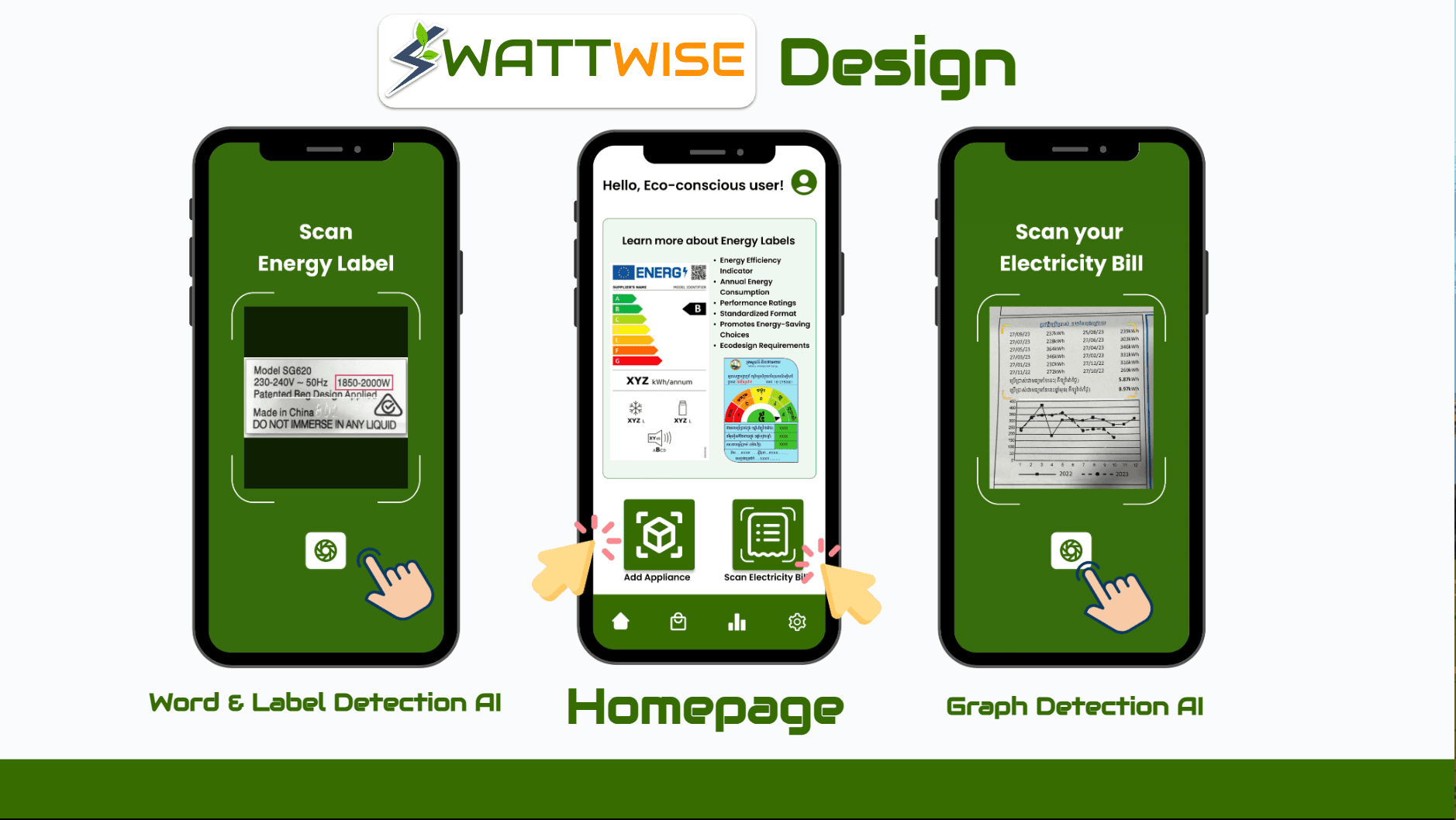
I designed WattWise around scanning rather than typing, because the information already exists on paper and re-entering it is the step people abandon.
Two capture paths feed one picture of a household's usage:
- Word and label detection reads the energy label off an appliance: model, voltage, wattage range, and the efficiency class.
- Graph detection reads the electricity bill, including the month-by-month usage table and the consumption chart, so history comes in from the document itself.
The home screen leads with a plain explanation of what an energy label actually says (efficiency indicator, annual consumption, performance ratings, ecodesign requirements) so the app teaches the format while it uses it. The two capture actions sit directly under it as the primary buttons: add an appliance, or scan a bill.
The pitch tied the design back to the outcome the judges were asked to weigh: identifying where energy is wasted, so a household sees both a lower bill and a smaller carbon footprint.
Result
First place, and a $2,500 top prize, out of the field at the 2023 EPI²C Challenge, with teammates Seth Tharo Hour and Techngoun Leang and coach Professor Olta Myslimi. It was the team's first competition run by a partner university.
The design turns a household's own paperwork into its usage history, which is the part that makes advice specific rather than generic. Winning a sustainability-weighted competition on that idea was the confirmation that the scanning-first decision was the right one: the judges responded to the fact that it asks nothing of the user that they do not already have on paper.